
AI vs. ML vs. LLM, Explained: A Plain-Language Field Guide for Operators
Someone pitches you "an AI solution." Someone else says their product "uses machine learning." A third vendor says it's "powered by the latest LLM." All three might be describing the exact same few lines of code, or three completely different technologies with completely different costs, risks, and failure modes. Most operators nod along anyway, because pushing back means admitting you're not sure what the words actually mean — and in a market this loud, nobody wants to be the one asking "wait, what's the difference?"
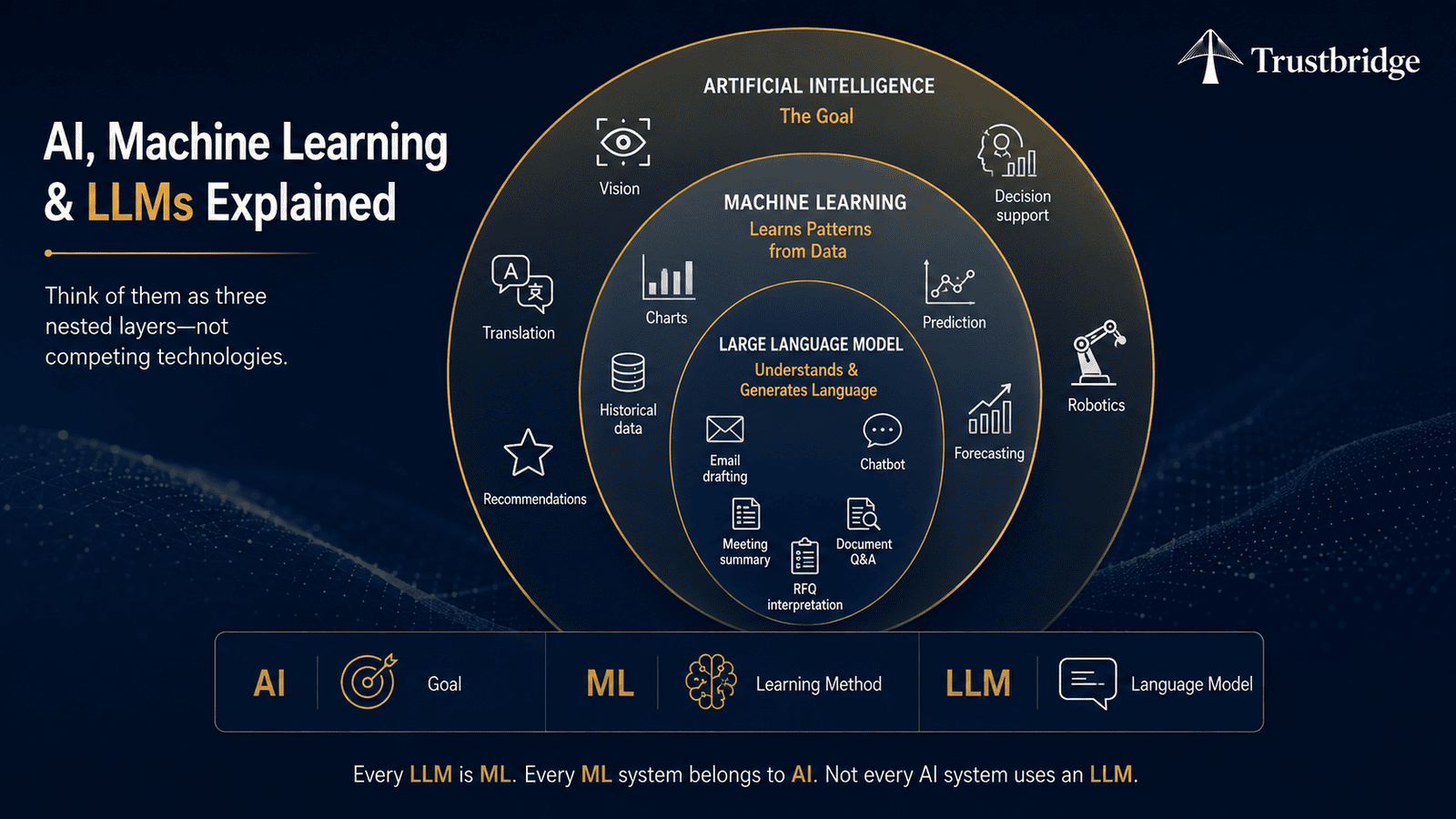
Here's the honest answer: none of these are competing technologies. They're three different sizes of the same nesting doll, and knowing which one you're actually being sold changes almost everything about how you should evaluate the pitch — the cost, the accuracy you should expect, what happens when it's wrong, and whether you need it at all. That's what this guide walks through — AI vs. ML vs. LLM, explained simply, without the sales pitch: what each term actually means, where each one is the right tool, and where it isn't.
Term | What it actually means |
AI | The umbrella goal — any system performing a task that normally needs human judgment. |
ML | The dominant method under that umbrella — a system that improves by learning from data instead of following fixed rules. |
LLM | One very specific, very recent type of ML — a model trained on enormous amounts of text to predict and generate language. |
Artificial intelligence: the umbrella, not the technology
Artificial intelligence is the broadest term of the three, and that's exactly the problem with it. AI simply means a system that performs a task we'd normally associate with human intelligence — recognizing a face, translating a sentence, flagging a risky loan application, drafting an email. It describes the job the system does, not how it does that job. A thermostat that "learns" your schedule and a system that writes marketing copy are both, technically, "AI" — which tells you they aim at some human-like task, and tells you almost nothing else.
That's why "AI-powered" on a landing page should trigger curiosity rather than confidence. The phrase is compatible with a hand-coded set of if-then rules from 1995, a statistical model trained on your company's own historical data, or a state-of-the-art language model — three things with wildly different price tags, accuracy profiles, and maintenance needs. When a vendor leads with "AI" and stops there, that's not a description, it's a category. The real question — which kind, built how — is still sitting unanswered.
Picture the spectrum: a spam filter running fixed keyword rules is "AI" by the loosest possible definition. A model that learns to flag spam by studying millions of labeled emails is AI too, and now we're solidly in ML territory. A system that reads an ambiguous, half-written support ticket and drafts a coherent reply is AI as well, and that's squarely LLM territory. Same three-letter label, three completely different builds, three completely different bills. The more useful question, and the one most people actually mean when they ask about AI vs. machine learning, is what's actually doing the work underneath the label.
Machine learning: the method doing most of the actual work
Machine learning is where things get specific. ML is the subset of AI where a system improves at a task by learning patterns from data, rather than following rules a person wrote down in advance. Feed it thousands of examples of quotes that turned into won jobs versus quotes that went nowhere, and a trained model can start scoring new quotes by likelihood of winning — without anyone explicitly coding the logic of "if the customer asks for X, they usually don't convert." The model finds the pattern; a person doesn't have to already know it going in.
This is the workhorse behind most of what actually gets called "AI" in production today: demand forecasting, fraud flags, predictive maintenance alerts, and — closer to home — the routing logic that decides which supplier in a network is the best fit for an inbound job. That last one is a trained model scoring fit against historical outcomes, not a chatbot reasoning its way through a paragraph. ML is at its best with structured, repeatable, well-defined problems: here's the input, here's the historical outcome, predict the next one.
It's also usually cheaper, faster, and more explainable than the alternative, which is exactly why it's the right tool far more often than the hype suggests. A well-trained classical model can tell you why it made a given prediction, in a fraction of a second and for a fraction of a cent — precisely the combination most operational decisions actually need, long before anyone should be reaching for something heavier.
Large language models: a very new, very specific kind of ML
So what is an LLM, exactly? A large language model is a particular kind of machine learning model — specifically, a deep learning model trained on enormous quantities of text to predict what word comes next, over and over, until it can generate fluent, coherent language on almost any topic. That single training objective unlocks something ML couldn't do well before: handling messy, unstructured input — a rambling customer email, a half-formed RFP, a meeting transcript — and producing something useful out the other side, whether that's a summary, a draft, or an answer to an open-ended question.
This is also what an LLM is not: it's not a database, it's not a calculator, and it's not guaranteed to be right. An LLM is, at its core, an extraordinarily sophisticated pattern-completion engine — genuinely excellent at language, reasoning-shaped tasks, and synthesis, and structurally prone to sounding confident even when it's wrong. Ask it the same ambiguous question twice and you may get two different, equally confident-sounding answers.
That combination is exactly why an LLM is the right tool for drafting, summarizing, and making sense of unstructured text, and the wrong tool for anything that needs a guaranteed, auditable, exactly-repeatable answer — the kind of job a simple, boring, classical ML model, or plain code, will still do better, cheaper, and more predictably. Reach for an LLM because the input is messy and the task is language-shaped, not because it's the newest name in the room.
Where the conflation actually costs you money
None of this would matter much if the three terms stayed in a textbook. They don't — they show up in vendor pitches, board decks, and internal build-vs-buy decisions, and getting the label wrong has a price. A company that pays for a custom "AI system" and receives what's actually a thin interface wrapped around an off-the-shelf language model has bought something that could have cost a tenth as much. A company that insists on "using AI" for a task that's really a simple, deterministic lookup has added cost, latency, and a new failure mode to a problem a spreadsheet formula already solved.
The generative AI vs. machine learning confusion is where most budgets actually get wasted, and it cuts both ways. Picture a supplier-matching pitch that promises "AI-driven quality scoring" while quietly running the same three-tier rating logic a spreadsheet could produce — the AI label added nothing but margin. Now picture the opposite: a team building a full conversational LLM interface just to answer "is this quote within budget," when a single trained threshold model would answer it instantly, for a fraction of the cost, every single time.
Teams reach for the more expensive option more often than they need to, mostly because "LLM" is the trendy word right now, and it's easy to assume newer means better. It doesn't, not for every job. The conflation isn't a vocabulary problem. It's a budget and risk-allocation problem wearing a vocabulary costume.
A mental model for evaluating vendor claims and internal proposals
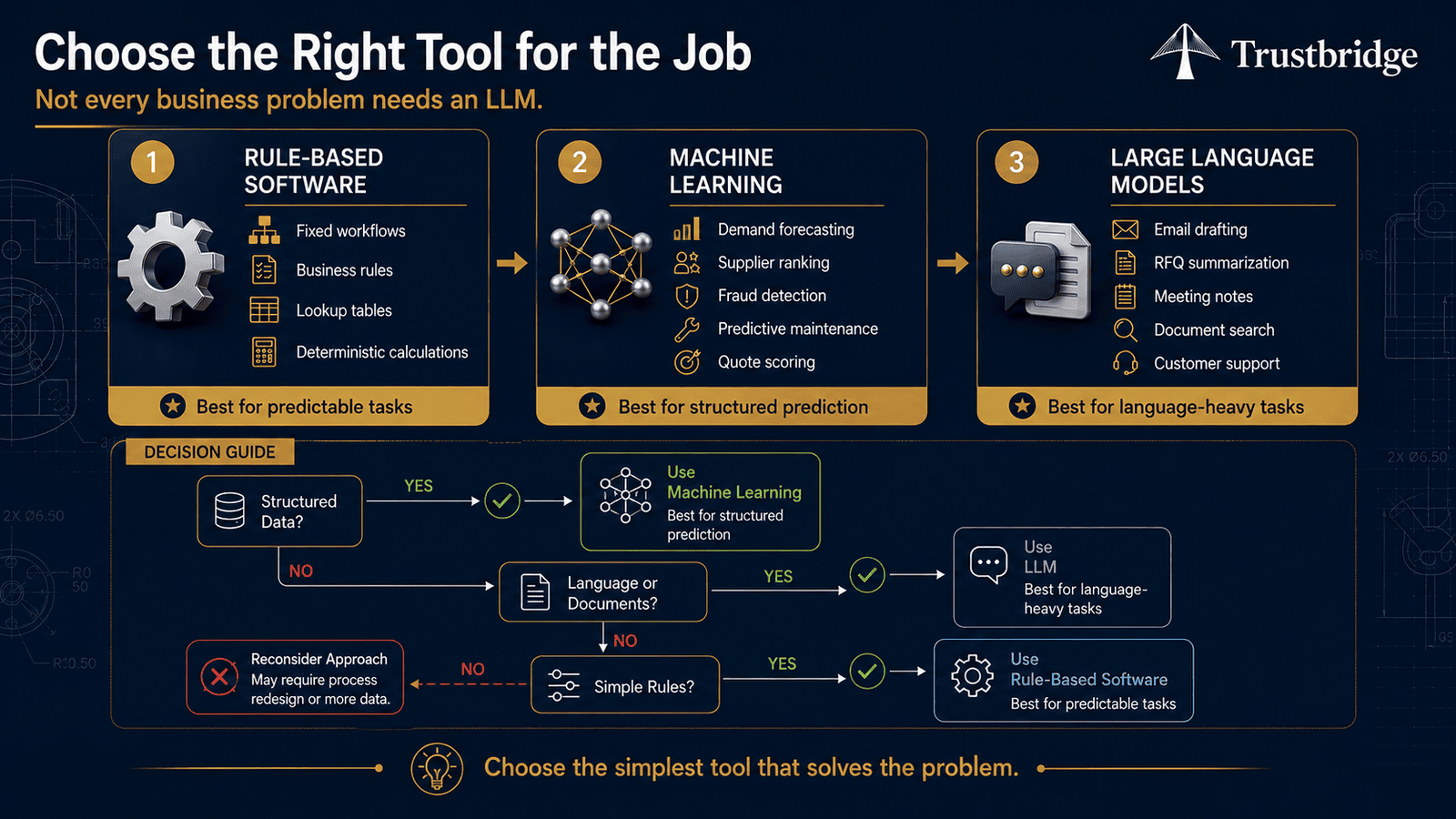
If you only take one habit from this piece on how to evaluate AI vendor claims, take this: ask one blunt question before anything else. What, specifically, is making the decision? Not "is this AI-powered," but is a person applying a fixed rule, is a trained model scoring a pattern, or is a language model generating language. That single question routes almost everything else, because the right follow-up questions are completely different depending on the answer.
If the answer is a trained model, the right follow-ups are about data: what was it trained on, how often is it retrained, and what happens when the real world drifts away from that training data. If the answer is a language model, the right follow-ups are about verification: what happens when it generates something plausible but wrong, is there a human or a hard rule checking its output before it reaches a customer or a decision, and how do you tell confident-and-correct apart from confident-and-wrong. Asking an LLM-shaped question of an ML system, or the reverse, wastes the meeting.
A second, cheaper filter: match the tool to the shape of the problem. Structured input, a well-defined target, and a need for consistency and explainability — that's ML territory, and it should usually be the default. Messy, unstructured input and a need to synthesize or draft — that's LLM territory. If a pitch reaches for a language model to solve a structured prediction problem, or reaches for a classical model to summarize a stack of emails, that mismatch alone is worth flagging out loud, whether it's coming from a vendor's slide deck or your own team's roadmap.
Conclusion
AI is the destination — a system doing something that looks intelligent. ML is the vehicle most of those systems actually run on — learning patterns from data instead of following hand-written rules. An LLM is one very capable, very new model of that vehicle, built specifically for language, and it is not a universal replacement for the other models on the lot. Keep that nesting-doll relationship straight, and most vendor pitches, along with most internal proposals, get a lot easier to evaluate on sight.
None of this requires a technical background to apply. It requires the discipline to ask "which one, exactly, and why" before signing off on the budget, the timeline, or the risk. That's a habit, not a certification — and it's the starting point for any real AI strategy for operators, ours included: the same filter we run every vendor pitch and every internal build decision through, inside our own ventures and alongside the operators we advise.
